
Author – Meena Raghunathan
When people hear the word Montessori, they often think of colourful classrooms, wooden learning materials, and children working independently. What is less widely known is that the Montessori method grew out of the work of Maria Montessori with children who would today be described as having intellectual and developmental disabilities (IDD).
Before becoming famous for her educational approach, Montessori worked with children who had been labelled “uneducable.” She believed that many of them had not failed to learn; rather, society had failed to teach them in ways that suited their abilities. More than a century later, that insight remains highly relevant.
Starting with Strengths
Traditional education often focuses on what a child cannot do. Montessori took a different approach. She looked first for a child’s strengths and built on them.
For children with IDD, this perspective can be powerful. Instead of concentrating on limitations, parents and educators identify abilities—whether in communication, creativity, movement, memory, or social interaction—and use them as starting points for learning.
Progress is measured against the child’s own development rather than against a standard set by others.
Learning by Doing
A core Montessori principle is that children learn best through hands-on experience. Learning materials are designed to be touched, sorted, matched, counted, and explored.
This approach works particularly well for many children with IDD, who may understand concepts more easily through direct experience than through verbal instruction alone.
Activities such as pouring water, arranging objects, preparing snacks, or working with simple educational materials help develop concentration, coordination, and practical skills. Learning becomes active rather than passive.
Respecting Individual Pace
One of Montessori’s most important contributions is the idea that every child learns at their own pace.
Families of children with IDD are often faced with comparisons—milestones reached later, skills acquired more slowly, or achievements measured against those of other children. Such comparisons can be discouraging.
Montessori reminds us that development is not a race. Meaningful progress matters more than speed.
A child who learns to dress independently, communicate a need clearly, or complete a daily task without assistance has achieved something important, regardless of how long it took.
Building Independence
Montessori education places great emphasis on helping children do things for themselves.
For families of children with disabilities, there can be a natural tendency to step in and help. While support is essential, children also need opportunities to develop independence.
Simple tasks such as buttoning clothes, organising belongings, preparing a snack, or making choices help build confidence and self-esteem. Independence is rarely achieved all at once; it grows through many small successes.
The Adult as Guide
In a Montessori environment, adults are encouraged to observe carefully rather than constantly direct. By paying attention to a child’s interests, strengths, and challenges, they can provide the right support at the right time.
This principle is valuable both in classrooms and at home. Careful observation often reveals abilities that might otherwise be overlooked.
AMC’s Montessori Journey
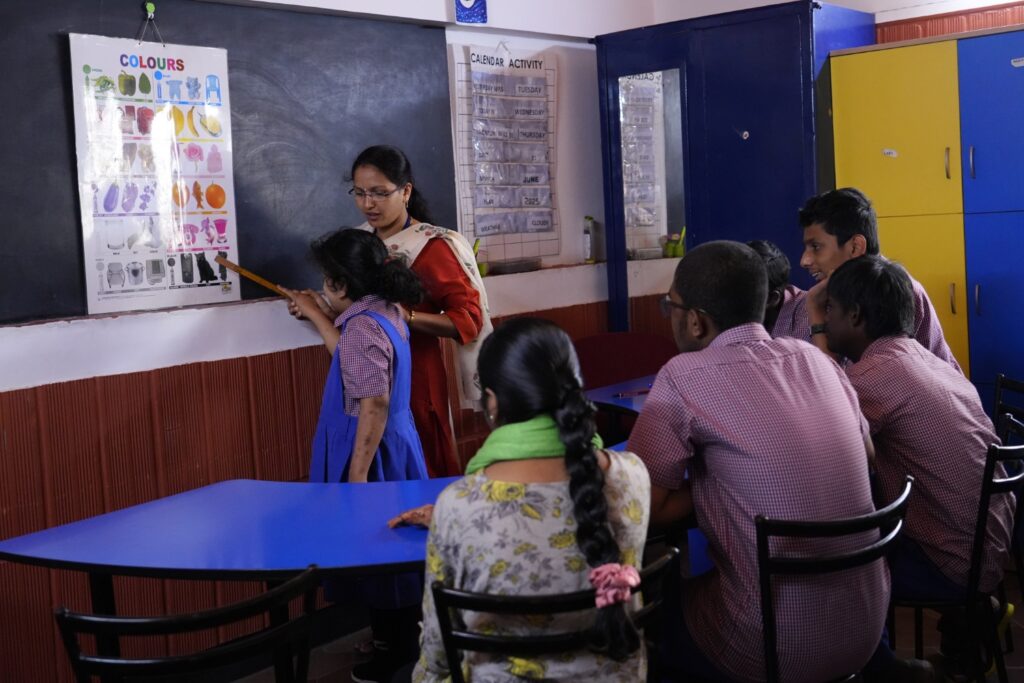
AMC has now converted its classrooms to Montessori classrooms, and provided teachers with training, so each of our children can benefit from this perspective and approach. Training and capacity-building workshops at AMC for educators over the past months have reinforeced educators’ perceptions about teaching children with diverse learning needs. Through the introduction of Montessori materials and hands-on learning aids, educators have seen how children can engage meaningfully, independently, and joyfully with their environment. The materials sparked curiosity not only in the children but also among the educators, encouraging them to explore new ways of presenting concepts and supporting individual learning styles. Through observation, discussion and shared experiences, educators are developing deeper understanding on how children will learn and grow in a prepared environment.
FROM POORNIMA, OUR DEDICATED MONTESSORI CONSULTANT
“One of the most heartwarming outcomes of my teaching journey at AMC has been seeing the excitement and anticipation that children bring to the classroom each day. As I enter the classroom, children often greet me with bright smiles and eagerly ask, “What new work are we doing today?” Their enthusiasm reflects a love for exploration. Montessori materials and thoughtfully prepared learning aids invite children to touch, manipulate, experiment, and learn through direct experience. I have observed and captured the many moments of curiosity, joy and discoveries as children engage with the materials in their own unique ways.” – Poornima Prathap, Montessori Consultant.
AMC would like to thank —-whose support has made this initiative possible.