
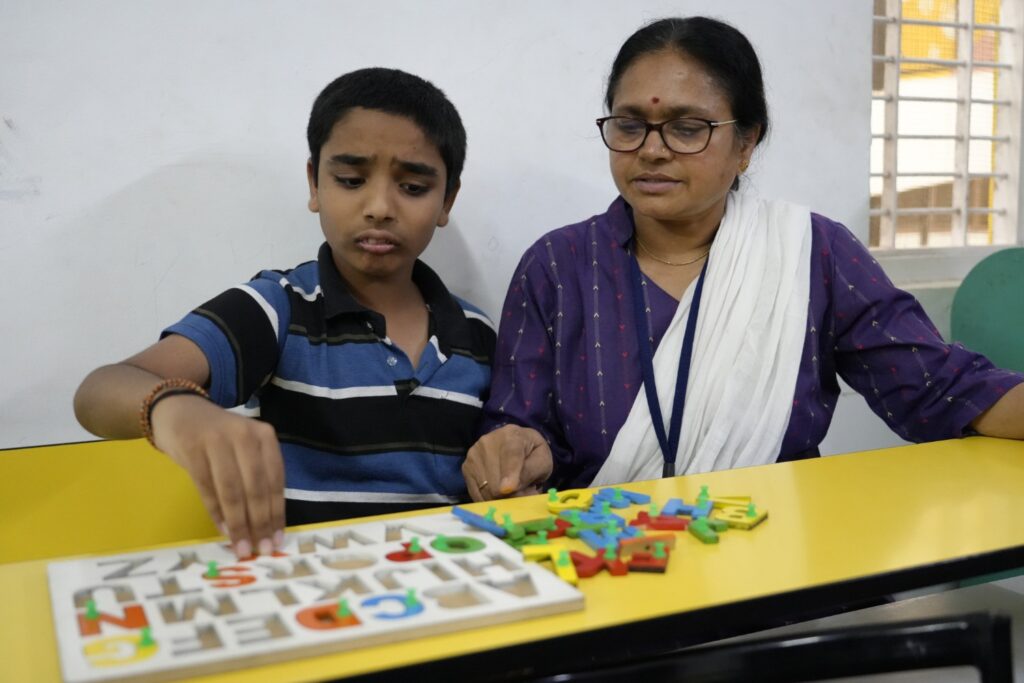
When the Parent Becomes the Professional
At AMC, some of the most dedicated members of our staff first walked through these doors as caregivers searching for help. What they found and what they have given back — speaks to the heart of what this organisation has always believed: that when you support one person, you change the lives of many.
For over six decades, the Association for the Mentally Challenged (AMC) in Bangalore has been doing something quietly radical. Its mission, simply stated, is to train, educate, and rehabilitate individuals with Intellectual and Developmental Disabilities (IDD) and to support their families towards a better quality of life. But embedded within that mission is a belief that has shaped AMC from the very beginning: that the family of a person with IDD is not just a bystander to their care. They are partners in it. And in many cases, they are the most equipped people to extend it to others.
This is how AMC came to employ a significant number of staff who began their relationship with the organisation not as professionals, but as parents. Mothers and fathers who arrived at AMC’s doors in search of a school, a programme, a lifeline for their child and who, over time, became the vocational trainers, workshop facilitators, and daily caregivers who now hold this community together.
Their stories are not just stories of employment. They are stories of identity reclaimed after years of invisible labour. Of depression survived and purpose rediscovered. Of women who were told, implicitly or explicitly, that having a child with special needs was something to be ashamed of and who found, within these walls, a community that knew better.
The Weight That Caregivers Carry
To understand why these stories matter, it helps to understand what caregiving for a child with IDD actually involves and what it costs.
Caring for a child with intellectual and developmental disabilities is not a part-time responsibility. It touches every hour of the day. It can mean being present for basic tasks like personal hygiene, eating, transportation that other parents hand over to their children gradually as they grow. It means navigating a healthcare and education system that is not always designed with your child in mind. It means carrying the weight of an uncertain future: who will care for my child when I am gone? How will they be safe? How will they be loved?
Research consistently shows that caregivers of children with IDD experience significantly higher rates of stress, anxiety, depression, and chronic illness than the general population. They often reduce or give up paid work entirely. They can become isolated, as social events and professional networks drift away. And they do much of this without recognition because caregiving, especially when it is done by women, is rarely counted as work at all.
AMC has always understood this. Its approach has never been to treat the child in isolation from the family. Programmes like Project ENRICH developed in collaboration with Dr. Srinivasa Murthy, retired Professor of Psychiatry at NIMHANS were built specifically to address the mental health, financial resilience, and long-term wellbeing of caregiver families. The Matheen Irfan Centre for Skills Development, inaugurated in July 2024, extends this commitment further: a fully equipped 2,600 square foot facility providing skill training in tailoring, candle-making, carpentry, computer literacy, and more — open to family members of AMC’s children as well as parents of special-needs children from other institutions, with a monthly stipend provided to those enrolled.
But long before the skills centre had a name and an address, AMC was doing something just as powerful and rather less visible: it was hiring the parents.
Their Stories, In Their Own Words
The following are a few of the many voices within our staff who began their journey at AMC not as employees, but as parents.
Gayathri R.N.
Vocational Trainer · 10 years
Gayathri R.N.’s first visit to AMC was for a routine parent–teacher meeting. She came as a parent. She left, for the first time, with a sense that something more might be possible.
What followed was a decade of growth as a vocational trainer — bringing compassion, structure, and quiet consistency to the students in her care, while her own daughter continued her journey at the same institution. The proximity — mother and colleague within the same walls — has given Gayathri something she describes simply but unmistakably:
“Being close to my daughter while also doing something meaningful for myself has brought me so much happiness. I truly wouldn’t want it any other way.”
For Gayathri, this was never just employment. It became a life that made sense in a way it had not before — one where her role as a parent and her role as a professional did not pull against each other, but held each other up.
Gayathri G.
Vocational Teacher · 2 years
Gayathri G. came to AMC as many parents come: slowly, and not entirely by choice. Her son — enrolled at AMC’s special school for the past ten years — lives with intellectual and developmental disabilities alongside severe ADHD. In those early years, she carried the caregiving largely alone. Her husband worked; the world offered little space for the complexity of what she was living with. Quietly, and then not so quietly, the isolation took hold.
“There was a time when I felt lost. I went through confusion, stress, even depression. I felt guilty and ashamed for having a special child, and slowly, I began to isolate myself.”
She is a B.Sc. graduate. She had her own ambitions once. In the years of intensive caregiving, she set them down and did not pick them up again — not because she forgot them, but because there was no space.
Two years ago, she joined AMC as a vocational teacher. What she found was not only a role, but a room full of people who understood her without explanation. Colleagues who had navigated the same terrain. A community that held no judgment, only recognition.
“Here, I have people I can talk to about anything and everything. There is no judgment, only support. I finally feel emotionally settled.”
She speaks about her son differently now. The guilt that once ran quietly beneath everything she said has been replaced by something steadier — a pride, clear and unhurried.
“I have a special child — so what? Just means he will be with me for a long time. He is my best friend.”
Sumaiya
Sheltered Workshop Trainer · 10 years
Sumaiya did not come to AMC looking for a career. She came looking for a school — the right school, the affordable school, the one that would see her son the way she saw him. The search had been disheartening. Suitable options were scarce. And the world, in the meantime, had its opinions.
“I have faced a lot of criticism because of my child. But I learned to face it head on.”
When she found AMC, something shifted. Her son found his place, first in the school, and eventually in the Vocational Training Programme. And Sumaiya — who had arrived as a parent in need of support — found herself becoming one of the Sheltered Workshop’s most consistent and valued trainers, a role she has held for ten years.
She is the sole breadwinner of her family. That is not a footnote. It is the frame within which everything she has built here carries its full weight. She comes to work every day providing not just care to her students, but stability to the people she loves most.
“This place has given both my child and me a new path. While my son is learning and growing, I am able to work and provide for my family.”
For Sumaiya, AMC is not simply a workplace. It is where survival became something more dignified — where she stopped searching and started belonging.
* * *
A Model Worth Naming
These three stories are among many. Across AMC’s vocational training centre, sheltered workshop, special school, and day care facility, there are staff members — trainers, facilitators, support workers — who came to us first as parents, and who have stayed to become the backbone of what we do.
This is not accidental. It reflects something AMC has always known: that the experience of raising a child with IDD, while demanding in ways that are rarely acknowledged, also builds something in a person. It builds patience of a particular and practical kind. It builds the capacity to meet someone exactly where they are, without frustration or hurry. It builds a commitment to dignity that comes not from a training manual but from years of fighting for your own child’s right to be seen.
When these parents join our staff, they bring all of that with them. And they find, perhaps for the first time, that what they have been doing all along — the invisible, uncounted, uncompensated work of care — is genuinely valued here.
AMC’s approach to caregiver empowerment extends well beyond employment. Project ENRICH offers structured mental health support, self-care training, and psychoeducation to families navigating the everyday realities of life with a child with IDD. The Skills Development Centre provides vocational training that opens pathways to entrepreneurship and employment for parents and siblings who might otherwise have none. These programmes exist because AMC understands that you cannot fully serve a child without also serving the family around them.
But the presence of caregiver-parents on our staff is something different again. It is a daily, visible reminder — to the families who bring their children here — that this place is one of possibility. That the difficult path they are on does not lead only to exhaustion. That the person who sits across from their child today may have once sat in their exact chair, feeling exactly what they feel now, and found their way through.
* * *
AMC has been a home for individuals with Intellectual and Developmental Disabilities in Bangalore since 1960. In six decades, it has learned something that no amount of theory can fully teach: that care is most powerful when it comes from understanding, and that understanding is most honest when it comes from experience.
The parents who became our staff bring that understanding every single day. They are not just employees. They are evidence — living, daily evidence — that support changes lives. Not just the lives of the children, but the lives of everyone who loves them.